Wednesday, January 12, 2022

The Trolley Argument

My aim is to address The Trolley Argument. It is based on the following two cases: 

ORGAN DISTRIBUTION
Jonathan kills his patient Nick and makes it look like an accident, after realizing that his blood is a match for five other patients in critical condition. Nick Is an organ donor and his organs are successfully transplanted into those five patients, saving their lives. No other organs arrived that day, and the five patients who will now live long, happy lives would have died had Jonathan not killed Nick for his organs.

TROLLEY DRIVER
Corrine is driving a trolley and sees five fraternity pledges tied to the tracks as part of an initiation ritual. The only way to avoid killing them is to swerve the trolley onto a side track at an upcoming junction. Corrine decides to steer the trolley onto the side, but killing the pledge master, who is asleep on the side track. The pledges all live long, healthy lives.
And here is the argument:
The Trolley Argument
(TR1) If there is no morally significant difference between two actions A and B, then: if
A is the right thing to do, then B is the right thing to do
(TR2) Diverting the trolley was the right thing to do
(TR3) There is no morally significant difference between diverting the trolley and killing
Nick
(TR4) So, killing Nick was the right thing to do

The idea behind the first premise of the argument is based on moral equivalence. When comparing

two actions, if you can’t find a reason for them to be morally different, then if the first action is either moral or immoral, so is the second action. For example, lying to your mom is morally equivalent to lying to your dad. Lying to your mom is just as good or bad as lying to your dad, unless you can explain why one of these actions is morally better or worse than the other. Otherwise, they both carry the immorality of lying, regardless to who that action refers to.

The idea behind the second premise of the argument is mostly obvious. The right thing to do is always the one that results in the highest overall levels of happiness. Corrine did the right thing by diverting the trolley because she saved five lives. She did kill an innocent person, but she would have killed five innocent people had she not diverted the trolley. Since her action resulted in the highest overall levels of happiness, she did the right thing.

The idea behind the third premise of the argument is that the acts of killing Nick and diverting the trolley are morally equivalent. In both cases, one innocent person is killed in order to save five other lives. There is nothing morally different between those two actions, since they produce the same results.

My plan is to challenge premise TR3 by showing that there is a morally significant difference between diverting the trolley and killing Nick. In section two, I will present my criticism of TR3 and then in section three I will anticipate and address an objection to my criticism.

My Defense Against The Trolley Argument
Rule Utilitarianism:
Performing a certain action is the right thing to do if and only if it is prescribed by the
collection of rules that, if adopted, would have the greatest positive effect on overall levels
of happiness.
Based on Rule Utilitarianism, the moral thing to do in both situations is to decide to save the five people instead of the one. However, when comparing Jonath
an’s and Corrine’s situations, this is only true for Jonathan’s case. Killing Nick and diverting the trolley have morally significant differences.
First of all, Corrine is faced with a spontaneous decision and is supposed to figure out what to do

within seconds. She is in an unfamiliar situation, where she knows nothing about those pledges nor the pledge master. In contrast, Jonathan makes a decision under no stress, no rush, and in full knowledge of both his patients and Nick. Jonathan, therefore, has an advantage that doesn’t excuse his action from being immoral.

Furthermore, Nick and the pledge master are not on the same level of innocence, making the pledge master more morally permissible to kill than the five pledges. Specifically, the pledges are the pledge master’s responsibility. They ended up in those tracks because of the pledge master, since he is the one responsible for their initiation. By falling asleep on the side of the track, the pledge master knows that there’s a one in a million chance that a train can pass over him. He is doing something that is not usually normal, and Corrine could never expect to find people lying on the train tracks.

On the other hand, Nick goes to the doctor to get treated, not to get killed. Nick is not doing anything risky because going to the doctor is something usually normal. The pledge master had taken a risk by taking himself and his pledges to the train tracks. At the same time, Nick is not responsible for the five patients’ situation. He isn’t the one that put the other five lives in a risky situation, unlike the pledge master.

Therefore, the moral decision to make in Corrine’s situation is to kill the pledge master, while in Jonathan’s situation the moral decision is to not kill Nick.

Addressing an Objection to My Criticism
One might object that we can’t confirm that it’s the pledge master’s responsibility that the pledges are tied to those tracks. With that in mind, the pledge master is as innocent as Nick. Also, let’s say that Nick was in a car crash with the other five patients and he is the one responsible for their condition. Would it then be morally permissible for Jonathan to kill him? Of course not. Maybe he would deserve it more, but that doesn’t make it right for Jonathan to kill him. Even if someone deserves to die, it doesn’t make it morally permissible for someone else to kill him.

In addition, even if it’s more difficult for Corrine to make that decision, it doesn’t affect the morality of her action. Therefore, there can’t be a moral difference with what Jonathan is doing. Suppose

there’s a serial killer walking into a house and immediately stumbles upon twins on his left side and a girl on his right side. He freaks out because he wasn’t expecting to see them at the door and has to

make a quick decision on who to kill. After a few seconds, he decides to shoot the girl and kills her, then walks out. Is his action moral because he was under stress and in a rush? Of course not. The result of the situation is the same and nothing can change it.

My reply to the first objection would be that my argument isn’t supposing that anyone deserves to die. It is calculating who would deserve to die more or less. Corrine isn’t killing the pledge master because he deserved it and she wants to kill him. She’s killing the pledge master because the pledges deserve it less than he does. As for Nick, the kind of responsibility he holds of getting in a car crash with five people is not the same as the pledge master’s responsibility that I mentioned in my argument. Nick’s car crash would be the result of an accident that Nick obviously would have no control over. The pledge master had the control of not being in the tracks and falling asleep. Nick couldn’t possibly be in control of his doctor not killing him.

As for the second objection, I would reply that the intentions of a person do change the morality of their actions. Corrine did not want to kill the pledge master nor the five pledges. The serial killer entered that house with the intention to kill. Therefore, Corrine’s rush and stress during her action only allowed her to save as many lives as she could, and make her actions moral. Jonathan, however, intended to kill Nick and under no stress, making his action immoral.

Being unconscious is the worst thing that can happen to you

My aim is to address the argument against fearing death.
Against Fearing Death
(FD1) You cease to be conscious when you die.
(FD2) If you cease to be conscious when you die, then being dead is not bad for you. (FD3) So, being dead is not bad for you.

(FD4) If being dead is not bad for you, then you should not fear death. (FD5) So, you should not fear death.

The idea behind the first premise of the argument is that death, under all conditions, results in your loss of consciousness. No matter what each religion believes happens after death, the only thing that is scientifically sure is that once you’re dead you’re no longer conscious. Right now, you can tell that you’re completely conscious since you’re aware that you’re alive, you’re aware of where you are and what you’re doing, and you’re aware of your thoughts and emotions. And you’re also aware of everything going on around you, such as your roommate walking in your room, the cars passing next to you on the street, and your friends calling you to come pick you up. Once you’re dead, however, you’re not able to experience nor understand any of those things, since you have no communication with the inner and outer world.

As for the second premise of the argument, in order to clarify what “bad for you” means, the author created HD*:

(HD*) Something is bad for you if and only if it results in more pain than you would otherwise have had.

Regarding that HD* is true, being dead is not bad for you. Since when you die you’re unconscious, and therefore can’t feel any pain, being dead is not bad for you. No matter how much pain you’re

feeling right now, it is more than the pain you’ll be feeling when you die. Of course, bad things will continue to happen after you die, but you’re not going to be able to acknowledge them. Nothing bad that ever happens will be able to affect you and cause you pain.

The idea behind the third premise of the argument is that there’s no reason to be afraid of death since it’s not bad for you. There’s nothing that can harm you when you’re dead. That means that there are no sources of fear either. You should be afraid of spiders, because they might sting you and cause you pain. You should be afraid of needles too, because your skin will be pricked by something sharp and cause you pain. Every single source of fear is due to something that will be bad for you. Being dead is not bad for you, so there is no reason to fear it.

My plan is to challenge premise FD2 by showing that losing consciousness is what makes death bad for you and not what excuses death from being bad for you, because unconsciousness ends all your pleasures. In section two I will present my criticism of FD4 and then in section three I will anticipate and address an objection to my criticism.

My Defence Against The Argument Against Fearing Death

Unconsciousness is in no way a reason to excuse death from being bad for you. On the other hand, unconsciousness is the reason why being dead is bad for you. Even though losing consciousness does not result in more pain than you would otherwise have had, it deprives you of all the pleasures that you can experience when you are conscious.

To support my argument I am rejecting HD* and modifying it into HD**:
(HD**) Something is bad for you if and only if it results in more pain or less pleasure than you would otherwise have had.
Regarding HD** is true, being dead is bad for you. That’s because when you cease to be conscious you stop living. Involved in “living” is not only the pain that you wouldn’t otherwise feel, but also the

joy that you wouldn’t otherwise feel.

Being conscious is the only thing allowing you to enjoy this life. It allows you to have feelings, thoughts, ideas, intuitions, and memories. Your consciousness is the only thing that allows you to have knowledge. Since all that you know is all that there is, your consciousness is the only thing that can confirm your existence. Without it you don’t exist. There is absolutely no case where you can agree that not existing is better than existing, since existing is the least that you could ever get. Humans are ego centric beings, meaning that the idea of us not existing scares us naturally. Therefore, consciousness is the most important thing that you possess right now, and the only thing allowing you to be somebody.

On the other hand, unconsciousness is bad for you for many reasons. First of all, once you die you stay dead forever. Death is not like a summer break, where you relax for a few months and then get back to your everyday life. You keep being dead for infinity, depriving you of everything that you could ever experience. Secondly, unconsciousness limits you to the complete unknown. Since all that you know is all that there is, not knowing anything is equal to nothing. Nothing isn’t better than something, no matter what that something is. Even if youre conscious and youre in pain, it is better than not to be conscious at all. Thats because pain can still offer you something good, such as making you stronger and more courageous.

Furthermore, when the author says that you shouldn’t fear death, they’re indirectly implying that you shouldn’t fear anything. That’s because every single fear is a result of your fear of death. Why are you afraid of spiders stinging you? Because their poison might kill you. Why are you afraid of heights? Because falling from a high surface might also kill you. You cannot accept every other fear and not accept the fear of death, because every other fear has the source of the fear of death. So, the author’s argument is basically leading to the conclusion that you shouldn’t be afraid of
anything. However, we need fear in order to have survival instincts and to be alert to danger, otherwise our lives would not have meaning nor purpose. Your fear of death might even be useful to you, because it makes you enjoy life more and not waste it.

Addressing an Objection to My Criticism

One might object that even though being unconscious deprives you of your pleasures, it does not mean that it’s bad for you. Once you’re unconscious you won’t be able to remember any of your joy and happiness. You won’t be able to remember anything from your life, so the loss of these pleasures will not affect you. Since death is inevitable and you’re going to cease to be consciousanyway, its not in your favour to believe that unconsciousness is bad for you. Its in your best interest to accept unconsciousness as an advantage of your death and live your life happily, without worrying. Imagine if you died and your conscious mind still continued to exist, reminding you of all the pleasures that youre no longer able to enjoy. The fact that you cease to be conscious when you die allows you to stay dead in peace.

However, it’s irresponsible to accept something that would potentially be bad for you, just because it is inevitable to avoid it. This suggests ignoring the reality of things and finding comfort behind excuses. You are conscious right now and you are aware of the pleasures that you are receiving right now. Therefore, these pleasures are important to you during the time that you are alive. You are also aware that you won’t be receiving these pleasures once you’re unconscious. This loss of pleasures will be bad for you, and youre not excused from fearing it just because it is inevitable. So, being dead is still bad for you and you should fear it, even though you cease to be conscious when you die.

Believing in God Has The Same Expected Utility As Not Believing in God

My aim is to address the argument for betting on God.
The Argument for Betting on God
(BG1) One should always choose the option with the greatest expected utility (BG2) Believing in God has a greater expected utility than not believing in God (BG3) So you should believe in God

Heres the idea behind the first premise of the argument. Suppose youre a competitive athlete and have a race coming up. You have one week left of practice and you really want to do well at your race. At the same time, you dont know if the training is worth it, because your chances of winning are not that high. So, you have two options: train hard and compete with a possibility of getting a podium, or dont compete and avoid all the wasted energy and stress. If you choose to train and compete, you will either win and your hard work will pay off, or you will lose. If you choose to not compete at all, you wont need to go through strenuous training but lose every possibility of getting a podium. But by choosing to train for your race, you have absolutely nothing to lose. Even if you don’t win, you still gain the experience and preparation for your next race, which you wouldn’t get otherwise. So, you should choose the option to train hard and compete, because it has the greatest expected utility. Its in ones favour to always choose the option that will benefit them the most. Suffering is unpleasant, which is why everyone prefers to take actions that have a positive outcome on them. It doesn’t make sense to ever choose an option that will cause you more harm than the other option would.

The idea behind the second premise of the argument is that you receive more benefits from believing in God than not believing in God. In other words, you’ve got absolutely nothing to lose by believing in God. You can only gain the best possible outcome. That is because if you believe in God and God turns out to exist, the expected utility is infinite. You will go to heaven and experience the best possible afterlife you can. And then, if you believe in God and God turns out to not exist, you still haven’t lost anything. Not believing in God, on the other hand, might result in the same or lower gain of benefits. If you don’t believe in God and God turns out to not exist, that’s great, you proved believers wrong, but still didn’t gain anything that will benefit you. If you don’t believe in God and God turns out to exist, that’s when you lose, because you will not get the benefits that God gives to believers (heaven). Heres the probability matrix the author uses to justify BG2:

page2image29339072 page2image29339264 page2image29339648 page2image29339456


My plan is to challenge premise BG2 by showing that disbelief in God has the same expected utility as belief in God. Specifically, I will show that disbelievers will not be deprived of heaven and other potential benefits of the afterlife and will receive the same outcomes as believers, in case God exists. In section two I will present my criticism for BG2 and then in section three I will anticipate and address an objection to my criticism.

My Defence Against The Argument for Betting on God

Belief in God doesn’t have a greater expected utility than disbelief in God. Even if God turns out to exist, believers and disbelievers get the same outcome. That is because God loves unconditionally all of his creations no matter if they have faith in Him or not. Its similar to the way a parent loves their child. No matter how many times you disrespect or disappoint your parents, they still love you. Maybe they dont like you or respect you, but they always love you, because its in their nature. Even if a human doesnt believe in God, they are still Gods creation. Ones faith doesnt change their nature and what God has prepared for them in the afterlife. Instead, the criteria for entering either heaven or hell are based on one’s character throughout their life.

I would argue that everyone goes to heaven, since Gods love is unconditional. But God cannot be that generous. And since religion is based on both a heaven and a hell, there must be some criteria for hell too. Thats why my argument is premised under the assumption that good people go to heaven and bad people go to hell.

Regarding that this assumption is true, being good doesnt refer to believers and being bad doesnt refer to disbelievers. There can still be bad believers and good disbelievers, which is why faith cannot determine ones consequence after they die. For example, between a believer that has committed murder and a disbeliever that spent their life doing community service, the disbeliever deserves to enter heaven, not the believer. Of course, there can still be good believers and bad disbelievers, but that would just be a coincidence with no correlation whatsoever.

Furthermore, the author says that youve got nothing to lose by believing in God. However, the author also failed to take into account that belief is a huge commitment that involves devotion. A person that is devoted to God spends most of their life going to church, praying, avoiding committing sins, and following religious principles. Even though every religious person offers a different amount of time to God, it is still some part of their time that they lose. Whether its praying three hours a day or one hour a week, its still wasted time. What a disappointment it would be for a believer to finally get to heaven and realize how many disbelievers are also there, even though they didnt go to church every Sunday.

Addressing an Objection to My Criticism

A possible objection to my argument might be that it is unfair for believers to get the same outcome as disbelievers. Part of my argument is the exact reason why: believers devoted a significant amount of time and energy throughout their life to praise God. God could not possibly ever disregard all the prayers, church visits, and dependency that so many humans went through only for Him. Disbelievers did nothing to deserve an afterlife of happiness. Even if a disbeliever is a good person, this doesnt change the fact that by not believing they showed doubt and disrespect toward God.

My reply to that objection would be that God doesn’t want our belief to be formed out of
fear. Faith doesnt serve as a way of giving back” so that God will reward us with heaven and not send us to Hell. Since God doesnt want us to be afraid, He also doesnt expect us to be devoted to Him, which shows that he is not expecting anything more from disbelievers and excuses them for not having faith. Believing in God or not is your free decision. Sending disbelievers to hell for choosing not to have faith in God is basically punishing a person for having free will.

Conclusion

I have argued that believing in God and not believing in God have the same expected utility. I defended the idea that God loves all humans and doesnt send unfaithful humans to hell. I then showed that the criteria for heaven are based on ones character and not on ones faith. And I also showed that you have something to lose by believing in God and God turns out to not exist. Lastly, I addressed possible objections to my argument by saying that God respects our decisions and doesnt want us to believe out of fear.

Sunday, March 22, 2020

What makes one a psychopath- "YOU" Series


After watching the first two seasons of “You” on Netflix I am speechless. There’s not enough time or space to analyse the whole series. I would love to focus my attention on the main character, however. Joe Goldberg is the best example of a person that has countless mental health issues but aren’t visible at first sight. He reminds me of Ted Bundy, but Joe’s story has a different specialty.
Most people would call Joe a psychopath, or even a sociopath. However, I think his mental health is much more complicated than that. For starters, he constantly has the need to be obsessed over someone. He craves to be involved in someone’s life and make them love him. Being independent is unknown to Joe, because he can’t deal with himself if he is not sharing his self with someone. He wants to feel valued, respected, honored, loved. Joe is severely co-dependent of his partner, which is why he is always in control of the women he’s dating. He feels insecure not knowing what his partner is doing, not because of lack of trust, but because of lack of independence.Αποτέλεσμα εικόνας για you series joe
Now, why was he a murderer? Or wasn’t he? Does killing make you a killer necessarily? After every murder he committed he would say “This is not me. I am not a killer” and then he would go and kill again. This is a clear sign of split personality disorder, as Dr. Nicky mentioned in the series. There is a part of Joe that is loving and caring and seeks good for others, but there’s also a part of Joe that seeks revenge through murder. Revenge for everything that went wrong in his childhood and isn’t his fault. Here is where Joe’s childhood PTSD steps in and shows that it’s the main reason Joe is capable of killing.
He grew up with an abusive father and a completely unstable mother. After leaving his father with his mom, he had to watch his mother being beaten many times by her boyfriends. Hiding in a closet every day, all he could feel was abandonment. He was never loved and never taken care of. All he knew was that he had to protect himself and his mom cause that was all he had. That’s when he committed his first crime, to protect the one person he craved care from. Once he pulled that bullet at the age of nine there was no coming back. That was now his way of defending his ground.
Later on his adolescence, it was no better when he lived with that bookstore guy. He was too strict on Joe, locked him up in a cage for hours, beat him, and burned him with his cigarettes. This is not exactly an image of a good childhood. Joe never in his life was loved by someone else. He felt as his existence was something random, that it would make no difference to anyone if he hadn’t been alive.
It turns out that the way this person was raised influenced his whole life. Had he been born in another environment with better circumstances he most probably wouldn’t have committed all those murders. It was all a reaction to his disturbed past.

Monday, January 27, 2020

Knowledge: what if we used the 100% of our brain?


There are many things I understand now that I couldn't when I was younger. For example, I have better managed the concept of time, and the passing of time. I have become more aware of death, disease, and generally danger and emergency. And there are many more things I'll probably understand later in life that I don't have the wisdom yet to understand now. The more I see,feel, and discover emotions and new states of mind, the more knowledge I gain.

Αποτέλεσμα εικόνας για brain capacityAs we grow older, we understand more things about the world. We gain consciousness. We become alert. The more we experience, the more knowledge we have about existence.
But some questions are never going to be answered. No matter how many things I experience, my brain will never be able to understand everything that exists, everything that "is". That is why we don't use our brain on its full capacity. It's nature's way of protecting us from realizing truths that would make us crazy. I've analyzed this further enough at my other article, though. The basic point I'm trying to reach here is: what would happen if we could use our brain to its full capacity?
What inspired me to think about this is the movie "Lucy" with Scarlet Johansson and Morgan Freeman. What happens in the movie is that the main character Lucy is injected with a performance-enhancing drug called CPH4 which basically causes some chemical reactions that somehow result in her using her brain on its full capacity. Of course, this kind of science is not proven legitimate and may lack many explanations, but it's very interesting to give it the benefit of the doubt and think what would happen if it was true.
Αποτέλεσμα εικόνας για matter and universeOnce the drug kicks in, Lucy is able to understand and control everything that exists. As she uses more and more of her brain's capacity, she moves from one dimension to the other. In the beginning, she starts to feel everything around her. She can feel space, the air, the vibrations, the people, the gravity, the rotation of the earth. She feels the heat leaving her body and the blood in her vains. She can access the deepest parts of her memory and remember feelings of touch, taste, and pain from when she was younger than one years old. As her usage of brain capacity increases, she is able to feel other people's bodies, thoughts, to identify diseases. She is able to access every single computer and control every source of electricity. Her brain absorbs every single piece of information that exists in the world. She reaches a point where she can travel in time. She goes back to the beginning of time, to the beginning of matter, where the first ever cell existed. Imagine being able to understand EVERYTHING. All that "is". She "unlocked" everything about existence.
So, after I watched the movie and let all of this kick in, I decided to conclude my brainstorming with a very simple yet disturbing idea: time is the only true unit of measure. There are no numbers. There is no 1+1= 2. We have codified our existence to bring it down to human size to make it comprehensible. We've created a scale so we can forget its unfathomable scale. Imagine a car speeding down the road. Imagine it going faster and faster and faster. Now, speed up this image infinitely and you'll notice that the car eventually disappears. So, what proof do you have of its existence? Time gives legitimacy to its existence. We all exist because of time. Time gives proof to the existence of matter.
I know, kind of scary and crazy. Thinking about stuff like this is just a reminder of how powerful and extraordinary life is.

Wednesday, November 27, 2019

Insomnia


We have all heard about the case of a patient who collapsed four years ago after overdosing on hypnotic pills. His family thought it was a suicide attempt, but when the patient came back he said he just wanted to sleep. Shan, 37, is one of the first doctors at Beijing University Hospital to specialize in psychiatric treatments and mainly insomnia. Medicine for the treatment of insomnia appeared in China in the 1980s.
Before then, all this was considered superfluous. In today's China, however, sleep disorders are common and widely researched. A study conducted by the Medical Committee on Sleep Medicine of the Chinese Medical Association ahead of the 18th World Sleep Day shows that over 60% of the adult population worldwide are not sleeping well.
Αποτέλεσμα εικόνας για insomnia"Especially young Chinese sleep very little. About 75% of people under the age of 30 suffer from sleep disorders due to depression, nervousness and anxiety. Stress at work, obesity, and poor nutrition can also affect sleep quality. Another major cause of insomnia is the use of smartphones, computers, and other electronic devices, as the screens emit a blue light that stimulates the optic nerve, leading to a significant decrease in melatonin, a hormone that regulates sleep. Those who suffer the most from insomnia, according to the survey, are media workers, IT developers, and e-commerce professionals.
A Chinese sleep research company released a report last year showing that 93.8% of young Chinese spend a lot of time online before going to bed. It is ironic, however, that these young people often turn to the Internet to combat insomnia. A report that came to light last December showed that nearly 79% of people who click the word "insomnia" to buy related products on the Alibaba platform are between 18 and 35 years old. The most popular products are tranquilizers and massage machines. In 2012, approximately 23.8 million people made online purchases between 11 pm and 5 am.
Wang Weidong, a leading sleep expert, has developed a mobile app that provides online diagnostics, medical advice, and traditional Chinese medical treatments. Since its launch in 2017, more than 30,000 users have subscribed and received information. In addition to conventional medicines, traditional recipes such as lavender oil for massage, recipes, and exercises are available online.
"Our generation is more susceptible to insomnia and we care about sleep more than our predecessors," says Match, the founder of the online group: "Sleep Bar - Say Goodbye to Insomnia", created in 2010 and has over 20,000 members. Match was always troubled from insomnia when he realized that constantly complaining about the problem was not the solution. He then began reading books on sleep medicine and sharing this knowledge online.
"Scientific methods are the key to improving sleep quality. Ultimately, the cure is inside the individual himself,” he says.

Monday, November 25, 2019

Criminal Psychology: Ted Bundy


A person who has the ability to kill another human being is not someone mentally okay. Almost all serial killers have a past that has caused them to become crazy. Take, for example, the case of Ted Bundy, a man who managed to kidnap, rape, and murder more than 30 young women. Bundy would grow up believing that his mother was his sister, and his grandparents were his mother and father. His maternal grandfather who at first raised him was racist, misogynistic, and altogether abusive. Bundy spent his adolescence across the country, removed from all he’d known as a child, raised by a stepfather who he felt no connection to.

Αποτέλεσμα εικόνας για ted bundy"When reviewing how troubled and disturbing Bundy’s childhood was, it’s no surprise that he turned out to be mentally sick. What is so interesting in his story is that he didn’t look nor act like someone who is a serial killer, and that’s how he covered up for his murders for about 7 years. He was tall, attractive, and generally good looking. However, what made him a great serial killer is that he was a genius.

He was so intelligent that took his appearance to his advantage and never failed to impress women. Women would trust him because he was charming. But isn’t that how society works anyway? Our reactions are not the same to every new person we meet. Take a homeless, old man and a young, attractive man in a suit. They both approach you and ask for your help with carrying something from their car. Who would you trust? The correct answer would be no one. Just because someone is attractive and is formally dressed does not mean that he is not a serial killer. Ted Bundy was so smart that he knew he was charming and he knew women would trust him because of his appearance.
But what was going on inside this man’s mind? He was not just a regular serial killer. He had no motive and no desire for revenge. He was just mentally sick and addicted. It’s like his mind was infected and felt like he would get satisfaction by killing. Like a smoker, his cigarettes were his murders. Every time he thought it would be his last one, he ended up having the need again. The creepiest fact in his case is that he only killed certain kinds of women. All of his victims were women, with long, dark hair parted in the middle. All of them were raped, before and after they were
killed.
 Αποτέλεσμα εικόνας για ted bundy"
So, after researching his story and past, it’s very interesting to find how many mental illnesses this person had: antisocial personality disorder, psychopathy, narcissistic personality disorder, bipolar personality disorder, borderline personality disorder, schizoid personality disorder, addictive disorder, and Machiavellianism. Imagine how hard was plain thinking for this person. When your mind is constantly kicked by so many anomalies, how are you supposed to act right? It’s scary to think how a monster can be created just from genetics.
The psychology that hides behind this story is fascinating. How a person can become inhumane after being raised abnormally, how our mind only can turn into a weapon without us realizing it, how we make instant conclusions based on what we see rather on what we know. Being a criminal is not a label for a person. It’s an identity for his/her mind.


Saturday, November 23, 2019

The scary theory of solipsism


Solipsism: the theory that my mind is the only conscious mind that exists. My self is the only thing that is real and everything else, including other people, is an illusion of my mind. Crazy and unbelievable, right?
Αποτέλεσμα εικόνας για solipsism"
Think about this. Everything that you know is a result of your brain receiving messages. All of your senses, what you see, what you hear, what you feel, is information that has been sent to your brain to help you perceive the world around you. But what if this information is just an illusion that your mind has created? What if everything that you see does not really exist, but is something created inside your brain? This is not totally impossible if you think about it. You don’t have any proof that everything you touch is real, because you only know what your brain receives. The scariest part comes when thinking about the existence of other people. If nothing exists, and it’s just your brain creating illusions, then no other conscious minds exist either. This is your reality, your world. Everything that happens and everything that you know is real is happening inside your own mind. There’s no material world, only the idea of it.

Αποτέλεσμα εικόνας για solipsism"Now, the reason why this theory is scary: it cannot be proven wrong. You are alone, living your own life with your own mind, and there’s no proof that all other minds and lives are real.  How can you be sure? You can’t. The only thing you can be sure of is that you exist. Everything else is open to doubt. 
I would advise you to not further analyse this theory because you’ll probably get crazy.  Just keep it in mind though, there’s a chance that you are the creator of this world, your own God, and the only thing that is real.

Monday, September 2, 2019

Brain in a box


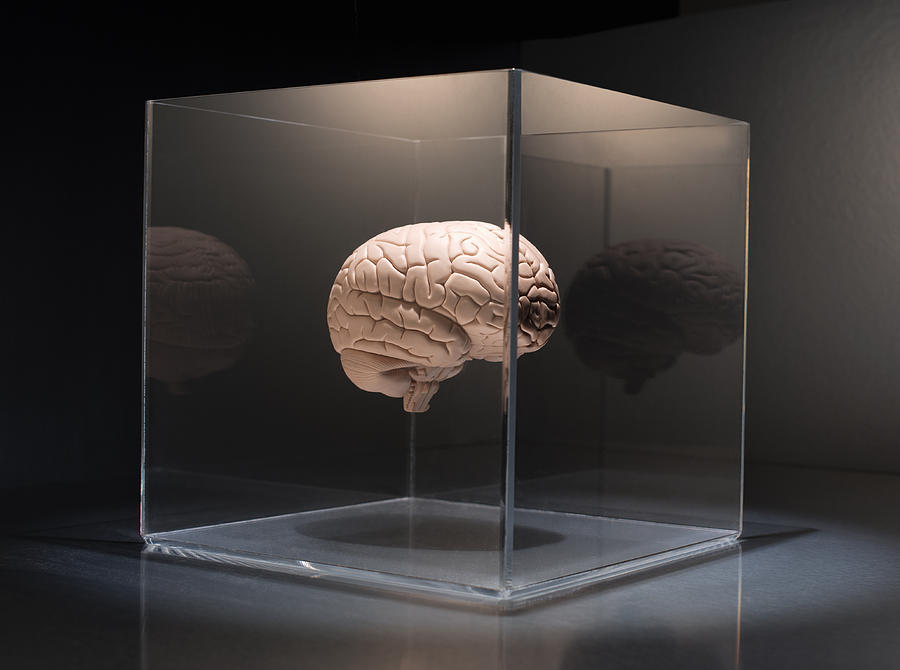
Αποτέλεσμα εικόνας για brain in a boxWhat if there is no material world? We don’t have direct access with reality, so we can’t really trust if anything exists. We absorb visual images with our eyes. We acknowledge sound through our ears. We touch objects and feel them through sensory messages sent to our brain. How do we know that all that we sense actually exists and it’s not just our brain talking?
We have no proof that there is material world. It’s more likely that we’re just a brain in a box. There is no universe and world, but only our mind that creates every single illusion. Descartes worried if what he sees is real or fake and concluded “I think therefore I am” but was always worried whether the real world was there. How can we be sure that we are not just a brain being fed false electrical signals by evil scientists? This sounds like a movie, maybe “The Matrix”, but you can’t be sure that the scientists controlling you are not already hundreds of years into the future.
Technology evolves so fast and so unexpectedly, that something like this will be possible in the future, some scientists claim. Maybe you’re one of these future experiments and you just don’t know it yet. 😉

Friday, June 28, 2019

This Weird Feeling

There’s a feeling I wanted to describe that hasn’treally been named. You know how you may sit alone in your room or walk on the street and just feel weird. It’s a kind of uncomfortableness, mainly with your surroundings. I usually feel that whenI realise the passing of time or when I do something that reminds me of my past. It’s not deja vu. I also feel it when I do something different for the first time that isn’t usual for my everyday life. It’s an odd feeling, where you just feel weird with yourself and your surroundings, just for a few seconds. It lasts only for a while and goes away really fast. But during those seconds that you feel it it’s so intense. It happens when I suddenly do something new and I feel like I’ve changed into a new person too fast. I don’t really know how to describe it. I feel it at random times, every few months.I don’t really know what it is, but after a lot of thinking I came to the conclusion that it is just a reaction of the brain to the realisation of change and evolvement. Sometimes it’s hard to just continue to do things and live your life without having a little “stop” and revising everything. It’s hard to get used to the idea that you continue to “evolve” no matter what. The years pass so fast that this “feeling” is a way of distinguishing one past reality from another. Things change so quickly that our brain doesn’t have time to process all the differences between the past and now. So maybe this “feeling” works as a notification from our brain, reminding us of our state right now. That’s why it’s extremely uncomfortable: it puts you in a position where you HAVE to be conscious in order to accept a change between the past and now. We’re not talking about big changes here. Maybe you just started brushing your hair with a different technique, and you just got used to it before realising you changed it. Maybe you took your driver’s license and it feels uncomfortable because you were another person when you didn’t know how to drive. Little changes can be scary, but that’s a way of getting out of our comfort zone.

Friday, May 31, 2019

Consciousness and Oblivion


It is so important to be conscious. I don’t mean just understanding what’s going on around you but also being able to process your surroundings and express your concerns about them. Realizing the value that a moment can have, absorbing the true nature of something. I believe that this consciousness, this realization of living, is the most powerful trait a person may have. I always felt conscious and aware of everything that’s going on from a very young age, which made me a very skeptical and sensitive person. I believe that the reason some people are more sensitive than others is because they can understand everything in a deeper meaning.

Αποτέλεσμα εικόνας για consciousness
By comprehending reality and actually being aware of what is going on and what life is, people get more emotional and thoughtful, because it is too much for the human brain to process so deep information about the world. That’s why as humans we use less than 30% of our brain. If we used the 100% we would get totally crazy, because we would be able to understand things about the world that from our human nature we are not capable to handle emotionally. Imagine being able to understand that the universe never ends, or that time doesn’t really exist, or that the universe will never stop existing. It’s our nature’s way of protecting us from realizing those scary truths.

My biggest fear has always been, is, and will always be oblivion. I am more scared of losing my consciousness than of dying. Because what is the point of living if you don’t comprehend life exactly as it is, in its most truthful and realistic way? If you can’t communicate deeply with other people and understand their view of the world, why even bother having human connections? If you don’t express your concerns about what “life” is and what it means to exist, how will you realize your own existence? 

Σχετική εικόναBut in the end, is consciousness a good or a bad thing? On one hand, you get to discover the world in its true meaning. On the other hand, will realizing those truths make your life better? The ultimate goal of life is pure happiness, right? Spending your life worrying about things that your brain is not able to control can make you feel scared and insecure, but also informed and aware. It’s safe to say that an easier and happier life is spent by not worrying about things, not caring about finding a deeper meaning to everything. By not being completely conscious, you protect yourself and ignore the scary reality of existence, which makes it easier for you to be happy and stress-free.

So, I guess there’s two ways to live your life, and I’m not sure if there’s a correct one. You either deal with life exactly as it is and concern yourself with everything that’s happening, or you choose to ignore the deeper and scarier meaning of life and end up happy. The most logical thing is to choose the second way that leads to happiness. But how is this happiness not fooling you when you know that there are so many real things about the world that you haven’t taken account of?

Wednesday, May 29, 2019

Kant's Approach To Experiences


Immanuel Kant was the only philosopher who managed to combine rationalism with empiricism. He proved that there’s not only one way or another. Combining reason and senses to prove reality is not an easy doing, and explaining it is not easy either, so let’s take this step by step.
We have experiences and create memories. We remember, we feel, we act. That’s how we work. But where does experience come from? Do we feel it directly, or is it something that just exists? Until Kant, there were two ways to understand experiences.

Αποτέλεσμα εικόνας για rationalism and empiricismBerkeley believed that there is no procedure of inner feeling. He believed that behind the impressions we get from our senses, there must be some kind of material substrate that we cant realize directly. That’s why, according to him, our ideas and what we acknowledge is all that reality is. “For something to exist it means that it is being acknowledged”. He supported that all that exists is souls and ideas and that reality is only one. The most important part of his theory is that everything in this world (which is not materialistic) exists inside God when it is not acknowledged by humans. He supported that God is “a priori”, and whatever He acknowledges exists.

Hume, on the contrary, didn’t think that the mention of God is essential. He believed that the imprinting of sensory impressions on the mind is enough. He thought that there is more to the outside world than what we can acknowledge, that we have a limited cognitive ability. As we can only collect data from 5 sensors, he thought that reality is wider than what our mind can understand. According to Hume, material objects have no objective substance, and we create their representations based on personal impressions. Eventually, he didn’t think that inductive generalizations have any real logical power.
Αποτέλεσμα εικόνας για kant immanuelHere is where Kant steps in as a pure empiricist. He took the rational mechanism of the mind and the input of knowledge through senses and made them cooperate. He made a new guess about the development of experience: experiences provide the “data” that the mind is going to process, and this data works as direct representations. The mind processes the representations that it receives, and the data gets modified with previous data of the mind. This shows that time and place are not dependent of experience but rather the condition for empirical perception to exist. Experiences are blind without understanding, and understanding is empty without experiences. According to Kant, “real stuff” are phenomena organized by the mind.
It was a big step to bring two opposite philosophical approaches into one. It may seem normal to some of us, but it’s not that easy to realize it on our own. Bringing rationalism and empiricism in piece is, in my opinion, one of the greatest achievements of man.

My thoughts on time,reality, and nostalgia


Why do good times end? That’s where we always end up, after thinking and thinking and brainstorming. Every single time it starts with the same thought and it ends with the same question, but the truth is, there’s no answer to that. You can’t really say why something ends or why something exists at the first place. The only difference between then and now is just time. Do things really change? Maybe they do. Maybe everything changes actually, because time can never be the same. It passes and passes and things change without realizing it. Even if you don’t want something to change there’s  nothing you can really do about it. You’re not the same person you were a second ago. It’s another time, another part of reality. As well as you’re not the same person you’re gonna be in one second. One. By reading this you now know more than you knew a second before, which makes you different. Well, that’s how life goes. When you experience something, even if you go back to the same place,with the same people, do the same stuff, it wont be the same thing, because you’ll be a different person, knowing more things than you did before. Knowledge is power. I finally understand this phrase. This is actually what existence is if you think about it. Knowing that you exist is existing. If you didn’t know you existed you wouldn’t really exist. Cause what is existence? Where do we exist? Some might say on earth, which is a planet in space. Okay. Then where does space exist? It’s all a matter of perspective, you see. By knowing that I exist and that others recognize my existence I can safely say this is a reality and not a fantasy. So, is it that we experience different realities everyday, and then we decide on which ones to stick ?


Αποτέλεσμα εικόνας για waves
  Now, there is a problem with good experiences: you either cry because it’s over or smile because it happened. I’m usually in a kind of combination of those two, for I get really attached to moments. I’m extremely happy that I get to be so happy and so full of life on numerous occasions, but at the same time I’m sad that I only get to experience a particular type of happiness only once. But is happiness even a choice? Do we want to be happy? Of course we do, but something tells us we're too stubborn to accept our happiness without being where we want to be. We keep punishing ourselves for some reason, as if it is our fault that time passes and we're not the same person as then. We keep thinking and thinking and trying to remember even more things just to feel closer to that reality. But that reality has passed. It does not exist anymore, which basically makes it a fantasy. The past doesn’t exist somewhere, it is not something real. Pictures are just representations of those realities, just ways of keeping a fantasy with us. The only thing “real” is RIGHT NOW. Imagine how many “nows” have passed. Countless. Then I think about how many nows I’ve spent thinking over fantasies. Usually there are times where I have lived more in a couple weeks than in countless months. So I guess the goal of life is not to live many years, right? Because this is proof for myself that quantity really doesn’t mean ANYTHING. So it’s not really time that exists, but moments. Time is relative, everything happens simultaneously. But moments, they are knowledge, which keeps our existence going. It’s all a matter of perspective. Distinguishing realities and fantasies. Adding value to a moment according to the knowledge it provided you for realizing your existence.


The Trolley Argument

My aim is to address The Trolley Argument. It is based on the following two cases:  ORGAN DISTRIBUTION Jonathan kills his patient Nick and m...